


Quake - Lisbon Earthquake Museum is an immersive museum in Belém, Lisbon, about the earthquake, tsunami and fires that destroyed the city on 1 November 1755. Across ten rooms of simulators and immersive sets, developed with a historian and seismologists from the University of Lisbon's Instituto Dom Luiz, visitors feel the shaking, learn how earthquakes work and see how Lisbon was rebuilt. It opened in April 2022.
Press & Media
Writing about Quake? This page has what you need: the facts, the history and science behind the 1755 earthquake, story ideas, quotes, photos and how to arrange a visit. If something is missing, ask us and we will get back to you within two working days.
01Quake at a glance
Quake is where the city of Lisbon begins.
Short description · about 60 words
- Visitors550,000+since opening
- Themed rooms1025+ interactive stations
- Visit length90 minentirely indoors
- Opened
20 April 2022
- Visitors
More than 550,000 since opening [as of date]
- Visit length
About 90 minutes, entirely indoors
- Format
10 rooms, 25+ interactive stations
- Languages
Portuguese, English, Spanish, French. Audio guides in 11 more languages. Staff are fluent in Portuguese and English
- Ages
Under 4s not admitted. Ages 4–5 free, view-only for the simulator. Simulator from age 6
- Address
Rua Cais da Alfândega Velha, 39, 1300-598 Lisboa (Belém)
- Opening hours
Daily 10:00–18:00. Last session starts at 18:00. Closed 24–25 December. [Opening hours on 31 December and 1 January]
- Founders
Ricardo Clemente and Maria Marques
- Tickets
Current prices and booking: lisbonquake.com/tickets
02Our story
Long before São Jorge Castle, the tiled façades or the view from a miradouro, there was 1 November 1755: the morning an earthquake, a tsunami and a firestorm brought Lisbon to the ground.
The decades of reconstruction that followed built the city travellers walk through today. In the Baixa, the grid of streets was laid out after the quake, on purpose, and you can still walk it. Quake puts visitors inside that morning.
Quake began as a project of co-founders Maria Marques and Ricardo Clemente around 2018. It was announced that year, with an opening first planned for 2020 on Rua da Junqueira in Belém. By October 2021 the plan still described six rooms; the final design grew to ten. Lisbon's then-mayor, Carlos Moedas, inaugurated it.
Full description · about 110 words
Quake - Lisbon Earthquake Museum opened on 20 April 2022 in Belém, next to the Museu Nacional dos Coches. Visitors follow Professor Luís, an elderly scholar, back to 1 November 1755, feel the earthquake from a moving church pew, see the tsunami and the fires that followed, and help recover the documents that shaped Lisbon's rebuilding. The experience was designed by Dutch themed-entertainment company Jora Vision, with historical and scientific content developed with historian André Canhoto Costa and seismologists Susana Custódio and Luís Matias of the University of Lisbon's Instituto Dom Luiz. It is run by Turcultur, founded by Ricardo Clemente and Maria Marques.
03The rooms
The rooms, in visit order
Quake counts ten themed rooms. This list starts with the reception, where the visit begins.
00Reception
Ticket purchase and RFID wristband hand-out for the visit.
01Waiting Area
Art-museum atmosphere with paintings related to the 1755 earthquake, building suspense.
02Professor Luís's Room
A cluttered laboratory-library where Professor Luís sets the mission.
03Training Center
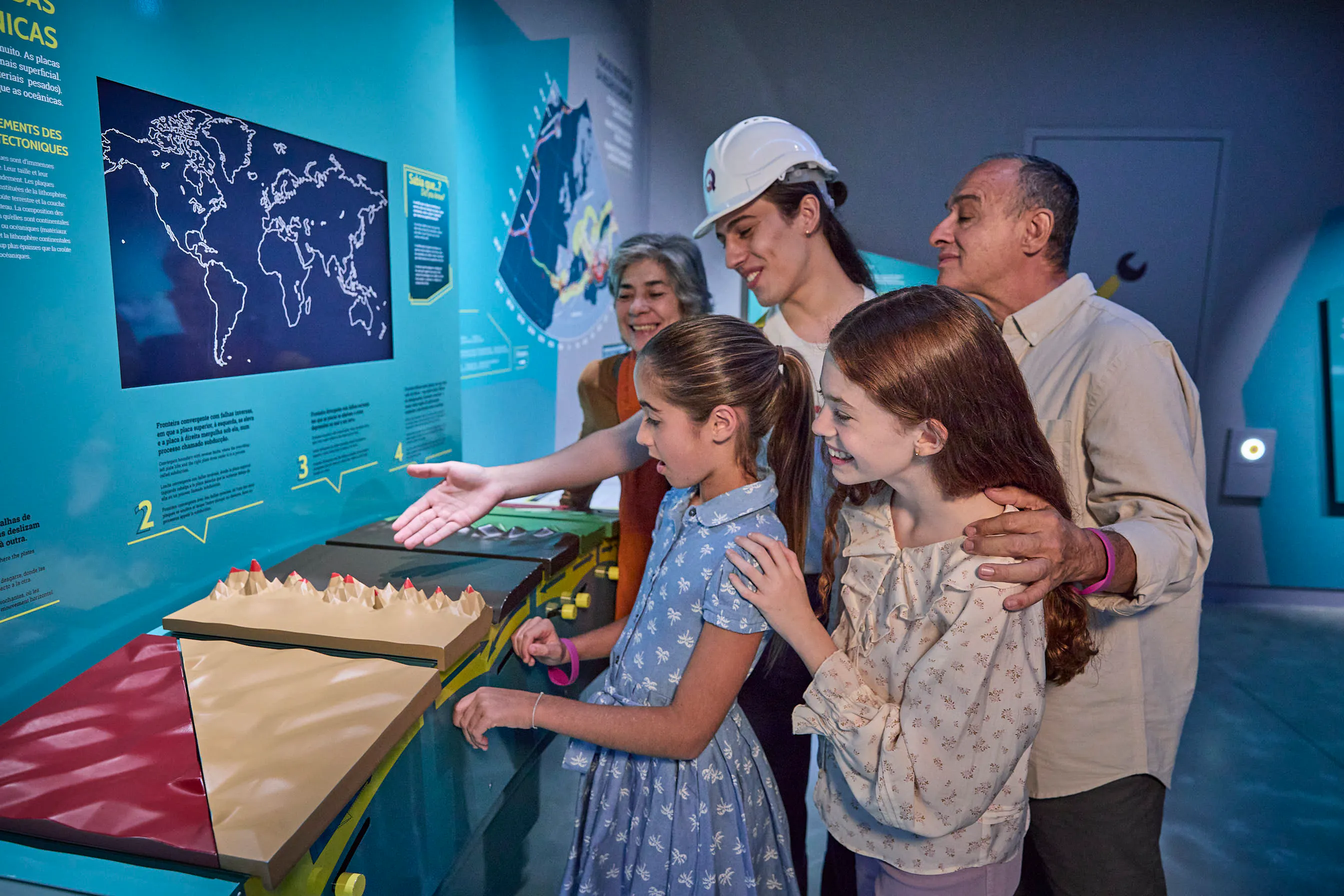
Interactive stations on tectonic plates and tsunamis, plus a tremor simulator (San Francisco 1906) and facts on the 2011 Tōhoku earthquake.
04Time Machine
A moving, illusion-filled room travelling back through history to 1 November 1755.
05Streets of Lisbon
Pre-earthquake Lisbon, immersing visitors in the sights, sounds and daily life of the period.
06ChurchCENTREPIECE
The visit's centrepiece: visitors sit on a moving church pew that recreates the force of the earthquake.
07Post-Earthquake Streets
Chaos, fire and rubble. Visitors learn the human toll and witness the arrival of the tsunami.
08Room of Tales
Survivor testimonies and the story of Lisbon's reconstruction, built around three historic documents: the emergency decrees of Sebastião Carvalho e Melo (later Marquês de Pombal), the Great Inquiry into the earthquake's causes, and Manuel da Maia's plan for the new Baixa.
09End Show
A video-mapping finale that brings the whole journey together and leaves visitors with a message of preparedness.
10Preparation Corridor
Practical earthquake-preparedness guidance and testimonials from people in other earthquake-prone regions.
041755 facts
1755: the facts you can use
If you are writing about the earthquake itself, start here. These facts are checked against Quake's own sources: 2019 content briefs by seismologists Susana Custódio and Luís Matias at the Instituto Dom Luiz (the Lisbon Earthquake Center), and Quake's official tour script. Magnitude and death toll are disputed among historians and scientists, so we give them as ranges. Please keep them as ranges in your piece.
How to use it:
- Safe to state
- Give as a range
- Say "about"
- Use as written
| Fact | What we can say | How to use it |
|---|---|---|
| Date and time | 1 November 1755, about 9:40am, on All Saints' Day | Safe to state |
| The shaking | Three tremors, about 7–9 minutes in total | Safe to state |
| Magnitude | About 8.5. Some studies suggest up to 9.1 | Give as a range. Still debated |
| The tsunami | Reached the area of today's Praça do Comércio about 90 minutes after the first tremor. About 5m high in Lisbon, higher near Sagres and Cádiz | Say "about" |
| Deaths | Most studies agree the number of deaths was most likely between 12,000 and 40,000, in a city of about 200,000 | Give as a range. Historians differ significantly |
| Destruction | Of about 200 churches in and around Lisbon before the quake, only 20 remained. Only 15% of houses remained intact, although that estimate may include demolitions made to rebuild the city. The total damage is almost impossible to determine, but 53 palaces, 60 chapels and 46 convents were lost | Use as written. The house figure is an estimate |
| Reach | Felt across Europe and North Africa. The tsunami reached as far as Brazil and the Caribbean | Safe to state |
| Scale | Lisbon was Europe's 4th-largest city at the time, after London, Paris and Naples | Safe to state |
Go deeper
05Story ideas
Story ideas
Looking for a way in? Here are six angles, each with the kind of piece it suits. We are happy to help with any of them.
- 01
History you feel, not just read
A single defining day in European history, the earthquake that reshaped the Enlightenment, told in a way visitors feel physically rather than just read about
Suits: Travel, history
- 02
Belém's other big draw
Minutes from the Belém Tower and Jerónimos Monastery, a natural add-on for anyone writing about Lisbon's most-visited neighbourhood
Suits: Travel guides, itineraries
- 03
Built with scientists, not just designers
Developed with seismologists from Instituto Dom Luiz and historian André Canhoto Costa, so the science and history hold up to scrutiny
Suits: Science, culture
- 04
A family day out that does not talk down to children
Interactive, sensory storytelling that holds the attention of children and adults alike. Recommended from age 6
Suits: Family travel
- 05
Preparedness with a purpose
Through the Recordar 1755 movement, Quake gathers and preserves Portuguese earthquake memories and promotes self-preparedness and a society more resilient to seismic risk
Suits: News, features
- 06
Strong visual material
Ten themed rooms, a moving church pew that recreates the 1755 tremor, and a video-mapping closing show
Suits: Photo and video-led coverage
1 November: Quake marks the anniversary with the Movimento Recordar 1755. [What is planned this year, once confirmed.]
06Quotes & awards
Quotes you can use
Museums today are living spaces, where history, learning and emotion meet. At Quake, we want to create experiences that leave a mark, connecting visitors with the past, but also with the present.
Ricardo Clemente
Co-founder, Quake - Lisbon Earthquake Museum
Translated from the original Portuguese
The 1755 earthquake was more than a catastrophe. It should be remembered, and it should teach us to be better prepared.
Ricardo Clemente
Co-founder, Quake - Lisbon Earthquake Museum
Translated from the original Portuguese
What visitors say · TripAdvisor, September 2026
It's perfect. A guided trip back in time. An hour and a half that goes by too fast.
Patricia K
We thoroughly enjoyed the Quake experience. It was well done and very informative.
Ellen S
Awards · Awards you are welcome to cite.

World Travel Award
Europe's Leading New Tourist Attraction [year]

THEA Award, 2022
Outstanding Achievement, Historical Experience (Limited Budget). Awarded to Quake's design firm, Jora Vision

Remarkable Venue Award
Most Innovative Venue [year]
07Plan a visit
Plan a visit
The practical things readers always ask.
Getting there
Quake is in Belém, next to the Museu Nacional dos Coches and near Avenida da Índia. Buses, trains and trams link the area to central Lisbon and the south bank of the Tagus. Parking nearby is scarce.
What to expect
Check in, collect a free wristband, then wait in the first-floor café until staff call your group by wristband colour. The visit takes about 90 minutes and is entirely indoors. The last session starts at 18:00.
Good to know
Children under 4 are not admitted.
Ages 4–5 are free but cannot use the earthquake simulator. They can watch from a view-only area.
The route is entirely indoors, so it is not recommended for people with claustrophobia.
Some rooms use visual effects, lights and artificial smells. Not recommended for people with photosensitive epilepsy, breathing problems or other conditions sensitive to special effects.
The simulator is not recommended for pregnant women or people with reduced mobility, heart problems or back problems. They can watch the earthquake and the light and sound show from an alternative area in the same room.
Tickets
Prices move with demand, so check the live price before you publish. Book and see current prices: lisbonquake.com/tickets
- Adult€23.50 – €29.50Dynamic pricing (varies by date and demand)
- Child (6–12)€17.50 – €22.00Full experience, including the simulator
- Child (4–5)FreeView-only seat. Cannot use the simulator
- Senior (65+)€20.00 – €25.00
- Voucher (adult)€26.00Fixed-price gift voucher
- Voucher (kids)€20.00Fixed-price gift voucher for children
10% discount on tickets booked at least two days in advance. No cancellations. Date and time changes up to 48 hours before the visit cost €3.50 plus any price difference.
Prices as published on lisbonquake.com (dynamic pricing, checked 24 September 2026). [Re-check before the page goes live.]
08Downloads
Downloads
Everything here is free to use for editorial coverage of Quake. Please credit "Quake - Lisbon Earthquake Museum". [Usage terms to be confirmed.]
- ZIPLogosThe Quake logo in colour, white and black, with English and Portuguese versionsDownload the logos
- PDFFact sheetOne-page PDF with the key facts and the 1755 factsDownload the fact sheet
- ZIPPartner kitFor tour operators, travel agents and resellers: award badges, descriptions and visitor informationDownload the partner kit
09Request a visit
Request a visit or interview
Tell us what you are working on and we will come back to you within two working days.
Quake in the news
Recent coverage of Quake.
- SIC Notícias
Museu Quake procura “criar cultura sísmica” e preparar população para terramotos
August 2024 - NiT
Lisboa volta a 1755 com atores, música ao vivo e uma experiência especial no Quake
October 2026 - Condé Nast Traveller
The best things to do in Lisbon
July 2025 - Observador
Com a mudança da hora vem mais tempo para planos fora de casa
March 2024